

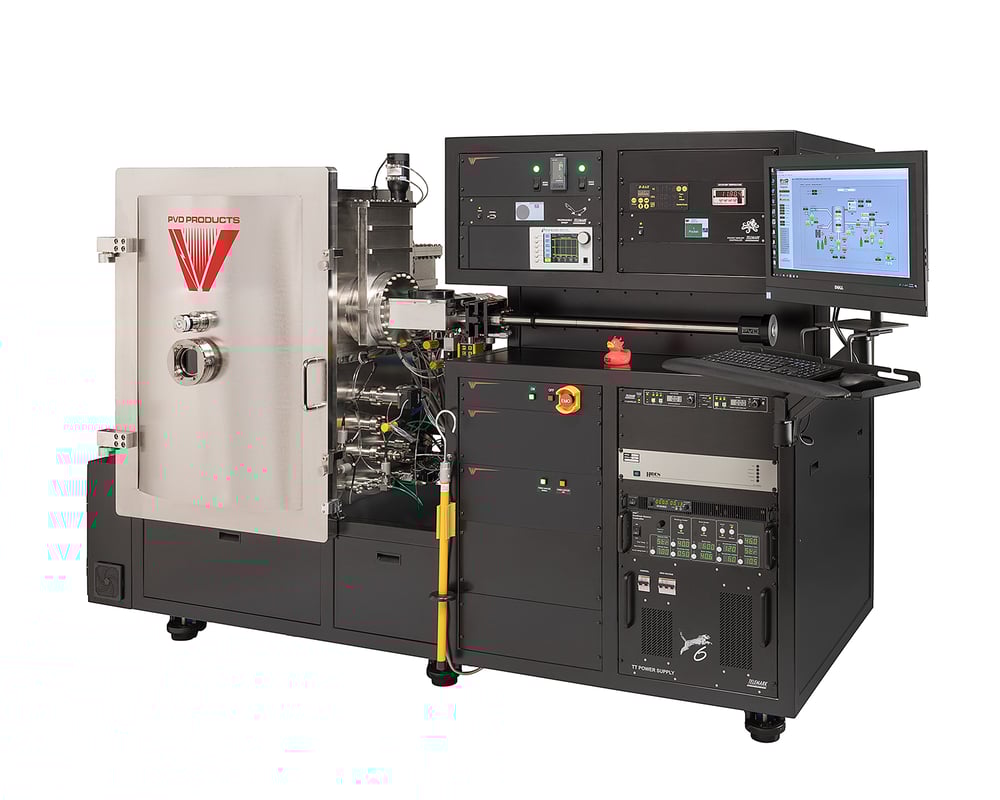
Evaporation Systems for Advanced Thin Films

Evaporation Systems for Advanced Thin Films

PVD Products designs customizable evaporation solutions engineered around specific deposition requirements, supporting single or multi-source configurations, automated controls, and ultra-high-vacuum architectures.

By combining thermal or electron beam evaporation with directed ion energy, these platforms support the development of durable, high-performance coatings across optical, electronic, and materials science applications.

Evaporation systems with integrated Ion Beam Assisted Deposition (IBAD) enable precise control over thin film composition, density, and adhesion for advanced research and production environments.



Download E-Beam Evaporation Systems Brochure


Integrated Power and Ion Source Technologies

Each system is fully equipped with advanced power supplies and deposition rate monitors, enabling precise closed-loop feedback control for consistent film quality. Substrate planetary or rotation stages can be configured with integrated heating capabilities exceeding 900 °C, depending on substrate size and material requirements.

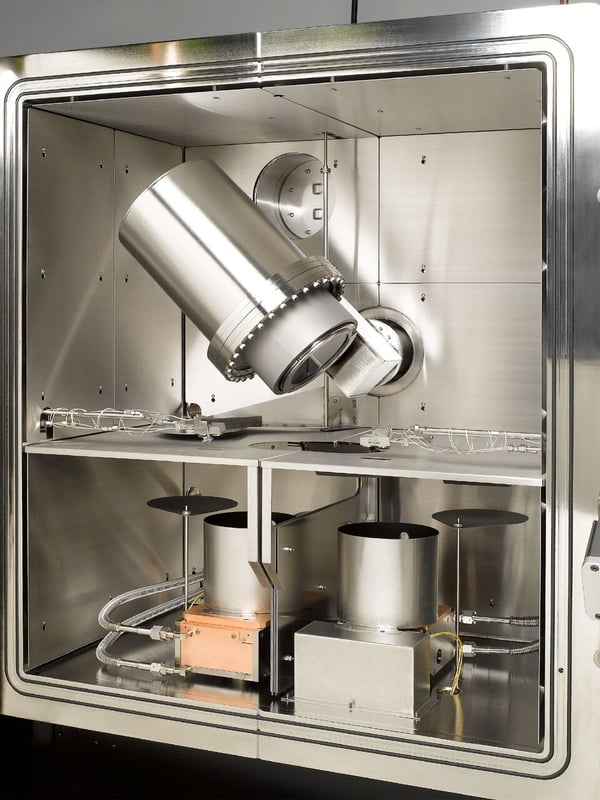
Additionally, Kaufman, End Hall, and RF ion sources can be seamlessly incorporated into the deposition chamber to support Ion Beam Assisted Deposition (IBAD) processes or perform effective substrate pre-cleaning, enhancing overall coating performance and adhesion.

Integrated Vacuum and Pumping Solutions

All evaporation systems are delivered with fully integrated pumping packages designed to support stable, repeatable thin film deposition. Configurations may include cryogenic or turbomolecular pumps paired with wet or dry mechanical backing pumps to accommodate a wide range of process requirements, from research-scale development to production environments.

Manual or electro-pneumatic valves, precision vacuum gauges, complete power distribution, electronic rack integration, water and air manifolds, and safety interlocks are incorporated into a unified architecture that prioritizes operational reliability and user safety.

Why Ion Beam Assisted Deposition?

Ion Beam Assisted Deposition enhances traditional evaporation by bombarding the growing film with energetic ions, increasing surface migration and reducing void formation. This results in improved coating density, enhanced adhesion, and greater structural stability compared to purely evaporative processes.

The additional energy delivered to deposited atoms can also influence microstructure and crystal formation, improving durability, wear resistance, and thermal stability

Performance Advantages of IBAD Coatings

Ion Beam Assisted Deposition (IBAD) produces dense, highly adherent coatings with improved abrasion resistance and mechanical strength compared to conventional evaporation. It's controlled ion energy enhances atomic packing and interface quality, reducing voids and lowering the risk of delamination.

These characteristics make IBAD very well suited for demanding applications where coatings must withstand mechanical wear, thermal stress, and long operational lifetimes while maintaining consistent performance.

33.jpg

Additional Equipment

Our advanced solutions feature multi-wafer planetary domes and precision substrate heaters engineered to accommodate a diverse range of substrate shapes and sizes. To ensure high-throughput efficiency and minimize contamination, our systems include integrated load locks capable of handling substrates up to 8 inches (200 mm) in diameter.

For specialized thin-film applications requiring extreme purity, we design custom ultra-high vacuum (UHV) systems that consistently achieve base pressures below 1x10⁻⁹ Torr.

Glancing Angle Deposition (GLAD) capability is available as an advanced equipment enhancement for organizations seeking to expand the functional performance of their thin films. Designed to integrate seamlessly within PVD Products' platforms, GLAD introduces precise substrate tilt and rotation control that enables the fabrication of engineered nanostructures, Josephson Junctions, and complex multilayer heterostructures, without requiring a completely new deposition architecture.


Frequently Asked Questions

What types of Evaporation systems does PVD Products offer?

PVD Products designs and manufactures thermal and electron beam Evaporation Systems, including platforms with integrated Ion Beam Assisted Deposition (IBAD). Systems are engineered to support precise thin film growth for both research and production environments.

How does PVD Products support process reliability?

Systems are engineered with stable vacuum environments, precision monitoring, and configurable controls to promote repeatable deposition conditions and consistent film quality.

What materials can be deposited using evaporation technology?

Evaporation systems can deposit a wide range of materials, including metals, dielectrics, and select compound materials used in optics, electronics, energy devices, and advanced research applications.

Can evaporation systems be customized for specific applications?

Yes. PVD Products develops configurable deposition platforms tailored to customer requirements, including chamber size, pumping architecture, evaporation sources, substrate heating, automation, and process control.

Which industries commonly use Evaporation and Ion Beam Assisted Deposition (IBAD) systems?

Evaporation and IBAD systems are widely used across advanced technology industries where thin film quality, material purity, and process control are critical.

Optics and Photonics: Produce high-density optical coatings for lenses, mirrors, filters, and laser components requiring precise refractive properties and uniformity.

Semiconductor and Microelectronics: Enable the deposition of conductive, dielectric, and barrier layers used in microelectronic devices while maintaining ultra-clean processing conditions.

Aerospace and Defense: Support the development of durable protective coatings designed to perform in extreme thermal and mechanical environments.

Advanced Materials Research: Provide the flexibility needed for universities, national laboratories, and corporate R&D teams developing next-generation materials and nanostructures.

Energy and Emerging Technologies: Facilitate thin film development for applications such as photovoltaics, battery technologies, and hydrogen systems where material precision impacts performance.

Magnetic and Quantum Technologies: Deliver controlled deposition environments necessary for magnetic films, spintronic devices, and quantum research applications.
What is Ion Beam Assisted Deposition (IBAD)?
Ion Beam Assisted Deposition (IBAD) is a thin film deposition process that combines physical vapor deposition  such as thermal or electron beam evaporation with controlled ion bombardment during film growth. The added ion energy increases surface mobility, enabling the formation of dense, strongly adherent coatings with precisely controlled microstructures.
Is IBAD suitable for research as well as production?

Yes. IBAD provides the process control and repeatability required for advanced research while offering the scalability needed to transition validated processes toward production.

What advantages does IBAD provide over conventional Evaporation?
IBAD enhances film density, improves adhesion, reduces porosity, and supports greater structural stability. These benefits make it particularly valuable for applications that require durable coatings, consistent material performance, and long-term environmental reliability.
Can Evaporation and IBAD systems be customized?
Yes. Systems can be engineered around specific deposition requirements, including chamber size, pumping architecture, evaporation sources, ion integration, substrate heating, automation, and process control. This flexibility supports both research-focused workflows and scalable production environments.
What is the difference between thermal and electron beam evaporation?
Thermal evaporation uses resistive heating to evaporate materials, suitable for low melting point materials and cost-sensitive applications. Electron beam (e-beam) evaporation uses a focused electron beam to heat materials, enabling deposition of high melting point materials with higher purity and deposition rates.
What applications are best suited for Evaporation systems with ion beam assistance?
Evaporation systems with IBAD are commonly used in optics and photonics, semiconductor and microelectronics fabrication, aerospace coatings, advanced materials research, magnetic structures, and high-performance dielectric films, especially where purity and film integrity are critical.
Do these systems support multilayer film deposition?
Multi-source configurations allow precise control over layer composition and thickness, enabling the fabrication of complex multilayer stacks with well-defined interfaces.

Customize A System

Do you know the specifications you need to reach?
Contact us to discuss a custom system.

Site Meter